
1.2.1: Random Pattern Generation#
- Duration:
12-15 minutes
- Level:
Beginner
Overview#
Random number generation is a fundamental building block of computational art and generative design. In this module, you’ll discover how simple random processes can create compelling visual patterns, from abstract color compositions to structured artistic grids inspired by pioneers like Gerhard Richter.
Learning Objectives
By completing this exercise, you will:
Understand how random number generators create visual patterns
Master the uniform distribution and its properties for image generation
Use Kronecker products to efficiently scale pixel patterns
Explore the relationship between randomness and artistic structure
Create your own variations of algorithmic art techniques
Quick Start: See Randomness In Action#
Let’s begin by creating something visually striking immediately. Run this code to generate a random color tile pattern:
 1import numpy as np
 2from PIL import Image
 3
 4# Set seed for reproducible randomness
 5np.random.seed(42)
 6
 7# Create 10x10 grid of random RGB colors
 8random_colors = np.random.randint(0, 256, size=(10, 10, 3), dtype=np.uint8)
 9
10# Scale each color to a 20x20 pixel tile using Kronecker product
11scaled_image = np.kron(random_colors, np.ones((20, 20, 1), dtype=np.uint8))
12
13# Save the result
14result = Image.fromarray(scaled_image)
15result.save('quick_random_tiles.png')
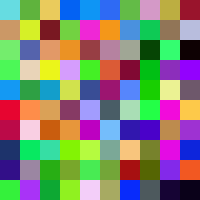
Random color tiles generated using uniform distribution#
Tip
Notice how each tile has a completely different color, yet the overall composition feels balanced. This is the power of uniform distribution. There is no color is favored over others.
Core Concepts#
Uniform Random Distribution#
The uniform distribution is the foundation of digital randomness. When we use np.random.randint(0, 256), every integer from 0 to 255 has an equal probability of being selected. This creates what we perceive as “pure randomness”.
# Every RGB value has equal 1/256 probability
random_rgb = np.random.randint(0, 256, size=(5, 5, 3), dtype=np.uint8)

# This gives us 256³ = 16,777,216 possible colors per pixel
total_colors = 256 ** 3
print(f"Total possible colors: {total_colors:,}")
For generative art, uniform distribution provides:
Unpredictability: No discernible patterns in individual elements
Visual balance: All colors represented equally over large samples
Infinite variety: Each generation produces unique results
Important
Setting np.random.seed() makes randomness reproducible. This is especially useful for debugging and comparing different algorithms on identical random inputs.
Kronecker Product for Scaling#
The Kronecker product (np.kron) is a mathematical operation that efficiently scales images by repeating each pixel into a larger block. Instead of using nested loops, we leverage this linear algebra operation for performance.
# Original: 2x2 array
small = np.array([[1, 2], [3, 4]])

# Scaling matrix: each element becomes 3x3 block
scale = np.ones((3, 3))

# Kronecker product result: 6x6 array
large = np.kron(small, scale)
# Result: each original value repeated in 3x3 blocks
For images, this transforms a small random grid into pixel-perfect tiles:
# Small random grid: 5x5x3 (75 total colors)
small_grid = np.random.randint(0, 256, size=(5, 5, 3), dtype=np.uint8)

# Scale each color to 40x40 pixel tile
tile_size = np.ones((40, 40, 1), dtype=np.uint8)
large_image = np.kron(small_grid, tile_size)
# Result: 200x200x3 image (40,000 pixels, but only 75 unique colors)
Note
The Kronecker product was named after Leopold Kronecker (1823-1891), though the operation itself appears in much earlier mathematical work. In computer graphics, it’s invaluable for creating pixel-perfect scaling without interpolation artifacts.
Color Space Considerations#
When generating random colors, the choice of color space dramatically affects the visual result:
RGB space: Uniform in red, green, blue channels independently.
Perceptual uniformity: RGB is NOT perceptually uniformed. Some random colors appear much brighter than others.
Gamut coverage: Random RGB covers the entire digital color palette, including colors that rarely appear in nature.
# These are all equally "random" in RGB space
color1 = [255, 255, 255]  # Bright white
color2 = [128, 128, 128]  # Medium gray
color3 = [255, 0, 0]      # Pure red
color4 = [1, 1, 1]        # Nearly black

# But they have very different perceptual brightness!
This creates visually interesting compositions because the eye perceives some tiles as “popping forward” (bright colors) while others decrease (dark colors) which adds implicit depth to a flat pattern.
Hands-On Exercises#
Now apply what you’ve learned with three progressively challenging exercises. Each builds on the previous one using the Execute → Modify → Re-code approach.
Exercise 1: Execute and explore#
Time estimate: 3-4 minutes
Run the following code exactly as written and observe the output. This creates a grid of random colored tiles.
 1import numpy as np
 2from PIL import Image
 3
 4# Create a 10x10 grid of random RGB colors
 5random_colors = np.random.randint(0, 256, size=(10, 10, 3), dtype=np.uint8)
 6
 7# Scale each color to a 20x20 pixel tile using Kronecker product
 8scaling_matrix = np.ones((20, 20, 1), dtype=np.uint8)
 9image_array = np.kron(random_colors, scaling_matrix)
10
11# Convert to image and save
12result_image = Image.fromarray(image_array)
13result_image.save('random_tiles.png')
14
15print(f"Image dimensions: {image_array.shape}")
Reflection questions:
What do you notice about the colors? Are any two tiles exactly the same?
Why does each tile appear as a solid block rather than individual pixels?
What role does the Kronecker product play in creating the final image?
Solution & Explanation
What happened:
np.random.randint(0, 256, …) creates a 10×10×3 array where each RGB value is randomly chosen from 0-255
np.kron() scales each color into a 20×20 pixel block, creating the tile effect
The final image is 200×200 pixels (10 tiles × 20 pixels per tile)
Key insights:
Each tile is a different random color due to uniform distribution
The Kronecker product efficiently repeats each color value into larger blocks
We get 100 unique colors (10×10 tiles) from 16.7 million possible RGB combinations
Exercise 2: Modify parameters#
Time estimate: 3-4 minutes
Modify the code from Exercise 1 to achieve these different effects. Change only the specified parameters.
Goals:
Subtle variations: Change the color range to create muted colors only
Grayscale tiles: Make all tiles appear in shades of gray
Larger tiles: Make each tile bigger for a bolder effect
Hints
For subtle colors, try limiting the range: np.random.randint(100, 180, …)
For grayscale, make all RGB channels the same value
For larger tiles, increase the scaling matrix size
Solutions
1. Subtle variations:
# Change this line:
random_colors = np.random.randint(100, 180, size=(10, 10, 3), dtype=np.uint8)
# Creates colors only in the 100-179 range (muted/pastel effect)
2. Grayscale tiles:
# Generate grayscale values and repeat across RGB channels
gray_values = np.random.randint(0, 256, size=(10, 10), dtype=np.uint8)
random_colors = np.stack([gray_values, gray_values, gray_values], axis=2)
3. Larger tiles:
# Change this line:
scaling_matrix = np.ones((40, 40, 1), dtype=np.uint8)
# Creates 40×40 pixel tiles instead of 20×20
Exercise 3: Re-code with discrete palette#
Time estimate: 5-6 minutes
Now create something new from scratch: a Gerhard Richter-inspired color grid using only specific color values.
Goal: Create random tiles that use only colors divisible by 32 (0, 32, 64, 96, 128, 160, 192, 224).
Requirements: * Use a 16×16 grid of tiles * Each tile should be 12×12 pixels * Only use the 8 discrete color values listed above
import numpy as np
from PIL import Image

# Create discrete color palette (values divisible by 32)
color_palette = np.array([0, 32, 64, 96, 128, 160, 192, 224])

# Your code here:
# 1. Create 16x16 grid of random indices into the palette
# 2. Map indices to actual color values
# 3. Scale up to 12x12 pixel tiles
# 4. Save as 'richter_style.png'
Complete Solution
 1import numpy as np
 2from PIL import Image
 3
 4# Create discrete color palette (values divisible by 32)
 5color_palette = np.array([0, 32, 64, 96, 128, 160, 192, 224])
 6
 7# Generate random indices into the palette for 16x16 grid
 8random_indices = np.random.randint(0, len(color_palette), size=(16, 16, 3))
 9
10# Map indices to actual color values
11small_array = color_palette[random_indices].astype(np.uint8)
12
13# Scale each color to 12x12 pixel tiles
14scaling_matrix = np.ones((12, 12, 1), dtype=np.uint8)
15image_array = np.kron(small_array, scaling_matrix)
16
17# Save result
18result_image = Image.fromarray(image_array)
19result_image.save('richter_style.png')
20print(f"Created {image_array.shape} Richter-style grid!")
How it works:
Line 6-8: Creates a limited palette of only 8 color values per channel
Line 11: Randomly selects from palette indices (0-7) for each RGB channel
Line 12: Maps those indices to actual color values using array indexing
The result has the structured, limited-palette aesthetic of Richter’s color charts
Challenge extension: Try different palette sizes or create complementary color schemes!
Summary#
In this exercise, you learned fundamental techniques for generating random visual patterns:
Key takeaways:
Uniform distribution creates unbiased randomness - essential for fair color sampling
Kronecker products provide efficient pixel-perfect scaling without interpolation
Color space choice dramatically affects visual perception of randomness
Discrete palettes can make random compositions more aesthetically pleasing
Controlled randomness balances algorithmic generation with design principles
Remember: Random doesn’t mean arbitrary. The most successful generative art combines algorithmic unpredictability with careful aesthetic choices about constraints, parameters, and color relationships.
This foundation in random pattern generation prepares you for more sophisticated techniques like cellular automata, noise functions, and emergent behavior systems.
What’s Next#
Continue to ../../../1.2_pixel_manipulation_patterns/1.2.2_cellular_automata/README to learn how simple rules can create complex, evolving patterns through cellular automata.
References#
Additional Resources
Sol LeWitt Instructions for Wall Drawings - Early examples of algorithmic art instructions
Casey Reas’ Process Compendium - Contemporary computational art using systematic processes
Vera Molnár: Algorithmic Art Pioneer - Historical context for computer-generated randomness in art