0.1.1 - What Is Generative Art#
- Duration:
15-20 minutes
- Level:
Beginner
Overview#
Generative art allowed traditional artists to transform into system designers by creating autonomous process that generate endless original artworks through code, algorithms, and change operations. In this module, you will discover how generative art has evolved from 1960s computer pioneers to today’s AI driven platforms and understand the core principles that define this revolutionary creative practice.
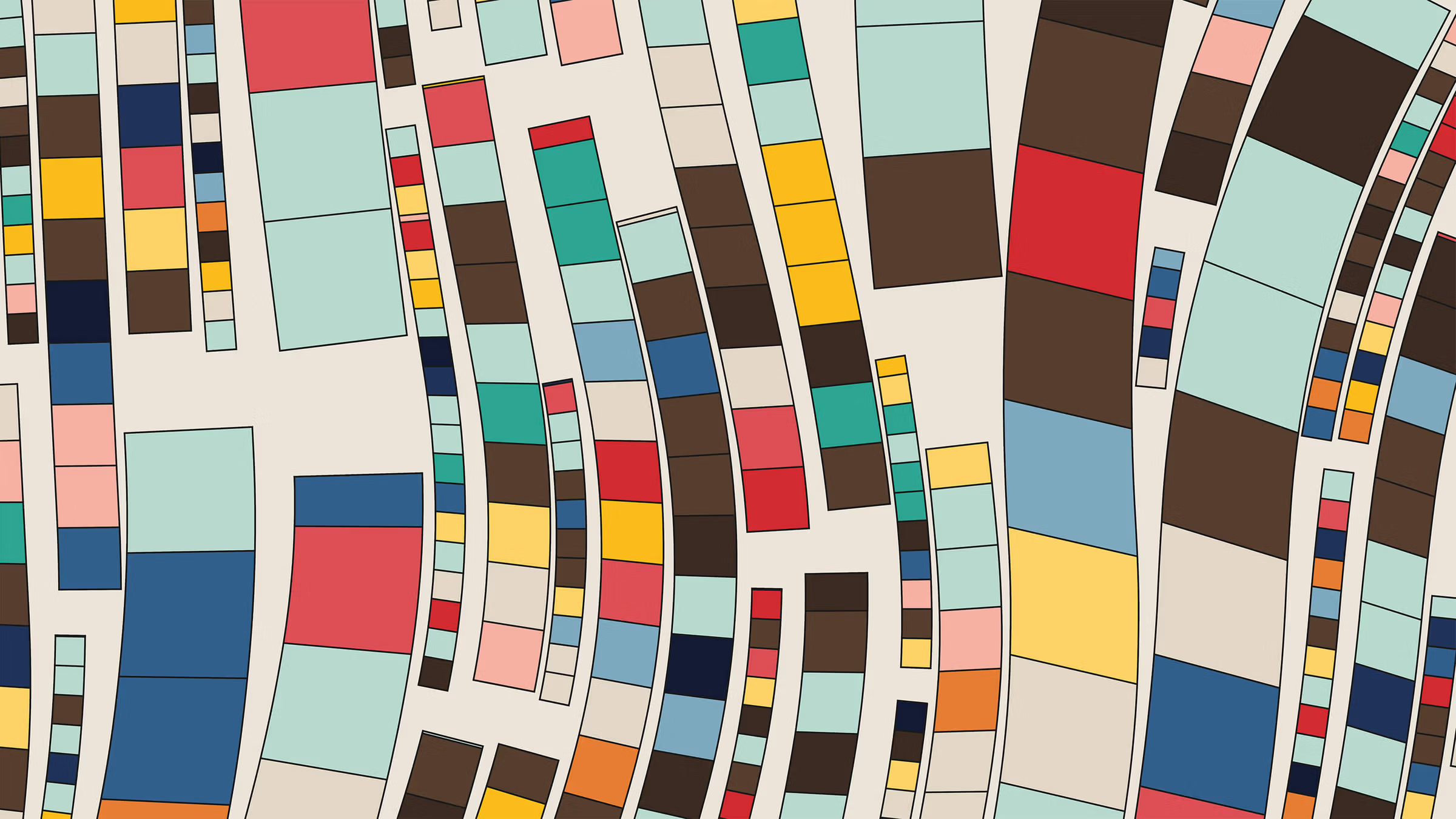
“Fidenza” by Tyler Hobbs (2021) [Hobbs2021]#
Learning Objectives
By completing this module, you will:
Understand the formal definition of generative art and its key characteristics
Recognize the difference between generative art and traditional digital art tools
Identify examples of generative art from different historical periods
Grasp the concept of system based creation and autonomous processes
Appreciate how generative art balances control and surprise
Quick Start: Identifying Generative Art#
Let’s start by understanding what makes art “generative.” Consider these three scenarios:
Scenario A: An artist uses Photoshop to manually paint a digital portrait, choosing every brushstroke and color.
Scenario B: An artist writes code that generates 1,000 unique geometric patterns, each one different based on random parameters.
Scenario C: An artist uses AI to transform a photograph into the style of Van Gogh’s “Starry Night.”
Quick Question
Which of these is generative art? Take a moment to think before reading on.
Answer: Scenario B is generative art. Here’s why:
Scenario A is traditional digital art—the artist controls every outcome directly
Scenario B is generative art—the artist creates a system that autonomously produces variations
Scenario C is computational art, but not generative—it’s a one-to-one transformation without autonomous generation
Tip
Generative art requires an autonomous system that can create multiple outcomes. The artist designs rules and parameters, then lets the system execute them with some degree of independence.
Understanding Generative Art#
The traditional definition#
Generative art is a practice where the artist utilize a system with defined functional autonomy that creates or contributes to completed artworks. According to Philip Galanter, the field’s leading theorist, three key elements define generative art practice:
System based design: The artist designs rules, constraints, and parameters rather than creating artifacts directly.
Functional autonomy: The system operates independently once initiated, making decisions without continious artist intervention.
Transfer of control: The artist gives up direct control over specific outcomes, embracing surprise and emergence.
In generative art, the creative act shifts from making individual pieces to designing systems that explore possibility spaces. Tyler Hobbs explains this clearly: “You’re not working towards a singular goal anymore, you’re trying to develop a whole system, a whole process for constructing good images.”
Traditional Art:     Artist → Creates → Artwork
                     - Direct creation of each element
                     - Complete control over final outcome
                     - Produces single or few artworks

Generative Art:      Artist → Designs System → System Creates → Artworks
                     - Designs rules and parameters
                     - Partial control - system makes decisions
                     - Produces potentially infinite variations
Important
Generative art is technology agnostic and it’s not limited to computers. Islamic geometric patterns, Bach’s algorithmic compositions, and even Sol LeWitt’s instruction guided wall drawings all contain generative principles, despite being created without digital technology.
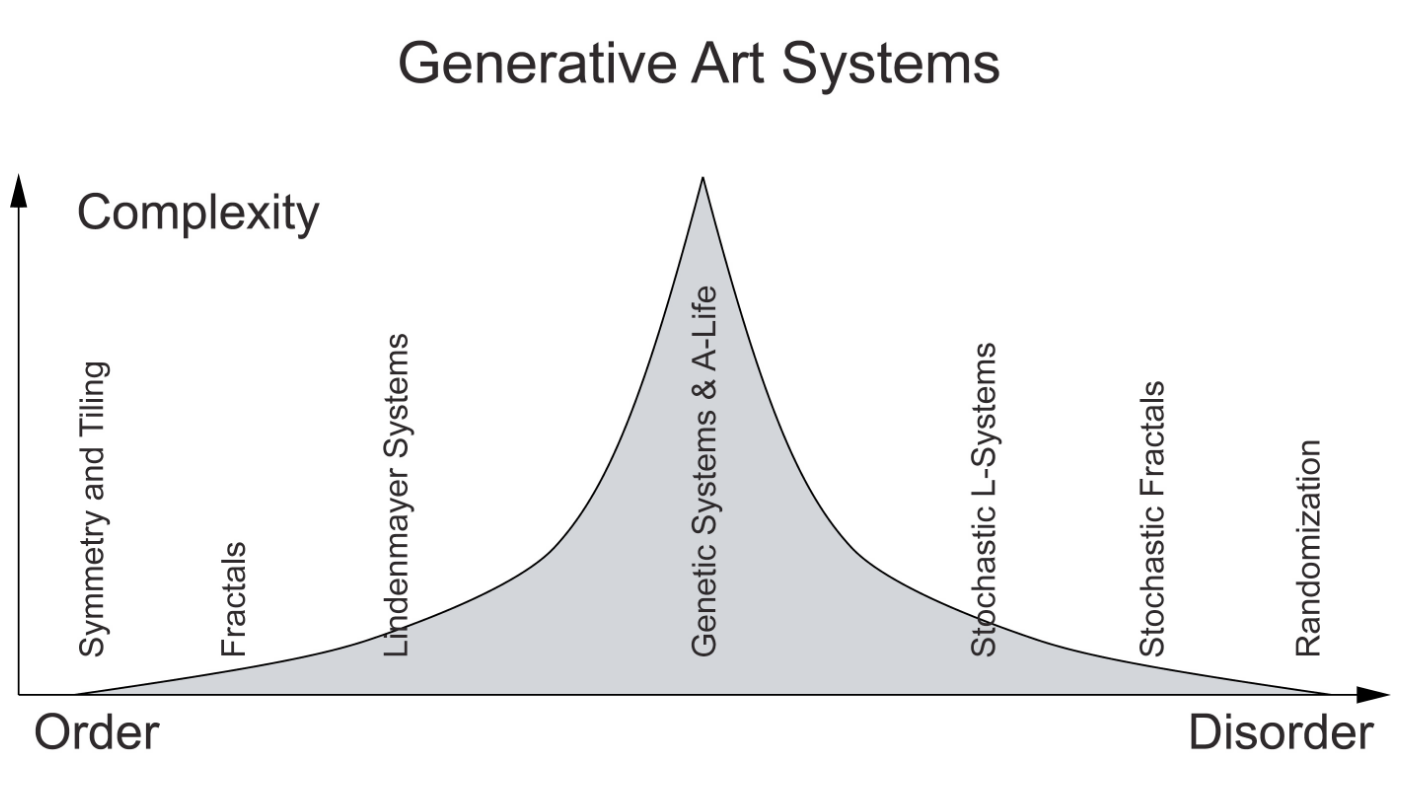
The spectrum from direct creation to system-based generation (Adapted from Galanter, 2003)#
Why autonomy matters#
The defining feature of generative art is functional autonomy. The system must be able to make decisions independently. Consider these examples:
High autonomy (Generative):
Harold Cohen’s AARON decides where to place lines and colors based on learned rules.
Tyler Hobbs’ Fidenza algorithm generates unique compositions from transaction hashes.
Conway’s Game of Life creates patterns from simple rules without any external input.
Low autonomy (Not Generative):
Photoshop’s blur filter (one-to-one transformation, no autonomy)
Manual digital painting (direct artist control at every step)
Pre-recorded animation (predetermined sequence, no variation)
Note
Randomness alone doesn’t make art generative! A script that randomly selects from 10 pre-made images isn’t generative. it’s just randomized selection. True generative systems create novel outputs, not just shuffle existing ones.
Historical context: 70 years of generative art#
Generative art didn’t start with computers. The practice has roots stretching back millennia:
70,000 BCE: Geometric ochre patterns from Blombos Cave show systematic repetition
Islamic Art (8th-15th centuries): Complex geometric tessellations based on mathematical rules
1700s: Mozart’s Musikalisches Würfelspiel (Musical Dice Game) uses chance to compose minuets
1965: First computer-generated art exhibitions by Frieder Nake and Georg Nees in Stuttgart
1973: Harold Cohen begins developing AARON, a 43-year collaboration with AI
2001: Casey Reas and Ben Fry launch Processing, democratizing creative coding
2021: Art Blocks creates blockchain based generative art platform, spawning a billion-dollar market
Did You Know?
Vera Molnár (1924-2023) developed her “machine imaginaire” in 1959, long before she had access to computers. She executed algorithms by hand, following step by step instructions to create series of drawings. This demonstrates that generative art is fundamentally about systematic process, not technology (Molnár, 1990).
Did You Know?
Philip Galanter’s research positions generative art within complexity theory, suggesting the most aesthetically interesting work balances order and disorder. Pure order is boring (perfectly repeating patterns), pure disorder is chaos (random noise), but the sweet spot between them creates “effective complexity”, which is now considered as the hallmark of compelling generative art (Galanter, 2003).
Generative vs. computational art#
Not all computer art is generative, and not all generative art requires computers. Understanding these distinctions helps clarify what makes art “generative”:
Computational Art (broad category):
Any art created with or displayed on computers
Includes digital painting, 3D rendering, video games, interactive installations
May or may not involve autonomous systems
Generative Art (specific approach):
Requires autonomous system that creates variations
Can be computational (most modern examples) or non-computational (Islamic patterns, instruction art)
Emphasizes process and system design over direct creation
Examples that blur boundaries:
Interactive installations: Often computational but not generative (user controls output)
Neural style transfer: Computational transformation, but not generative (one-to-one mapping)
Procedurally generated game worlds: Often generative (algorithms create landscapes autonomously)
Hands-On Exercises#
These exercises develop your ability to identify generative art and understand its core principles. Each builds on the previous using conceptual analysis rather than code.
Exercise 1: Identify generative characteristics#
Time estimate: 2-3 minutes
Review and examine each artwork description and determine whether it’s generative art. Identify which of the three key characteristics (system-based, autonomy, ceded control) each possesses.
Artwork 1: Sol LeWitt’s Wall Drawing #118 (1971)
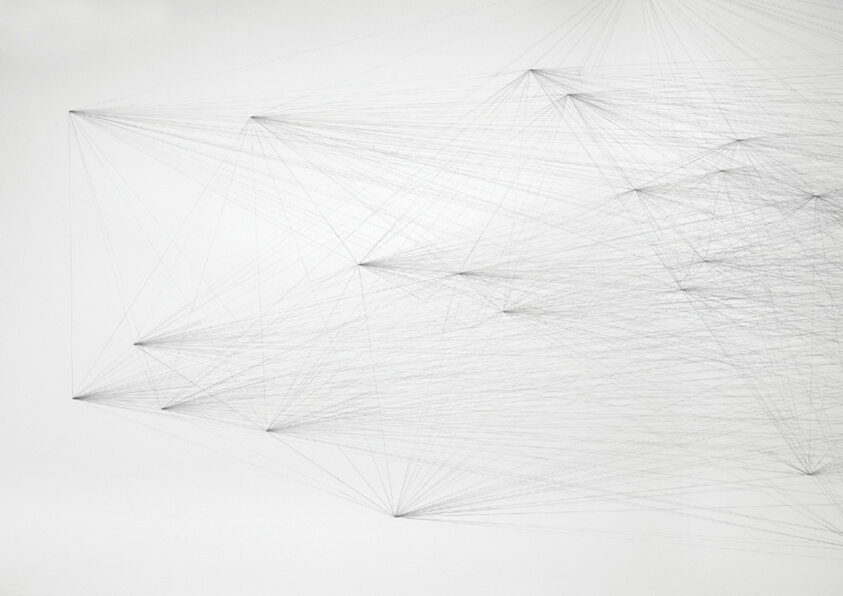
Sol LeWitt’s Wall Drawing #118 (1971) [LeWitt1967]. Instructions: “On a wall surface, any continuous stretch of wall, using a hard pencil, place fifty points at random. The points should be evenly distributed over the area of the wall. All of the points should be connected by straight lines.”#
Artwork 2: Refik Anadol’s Unsupervised (2022)
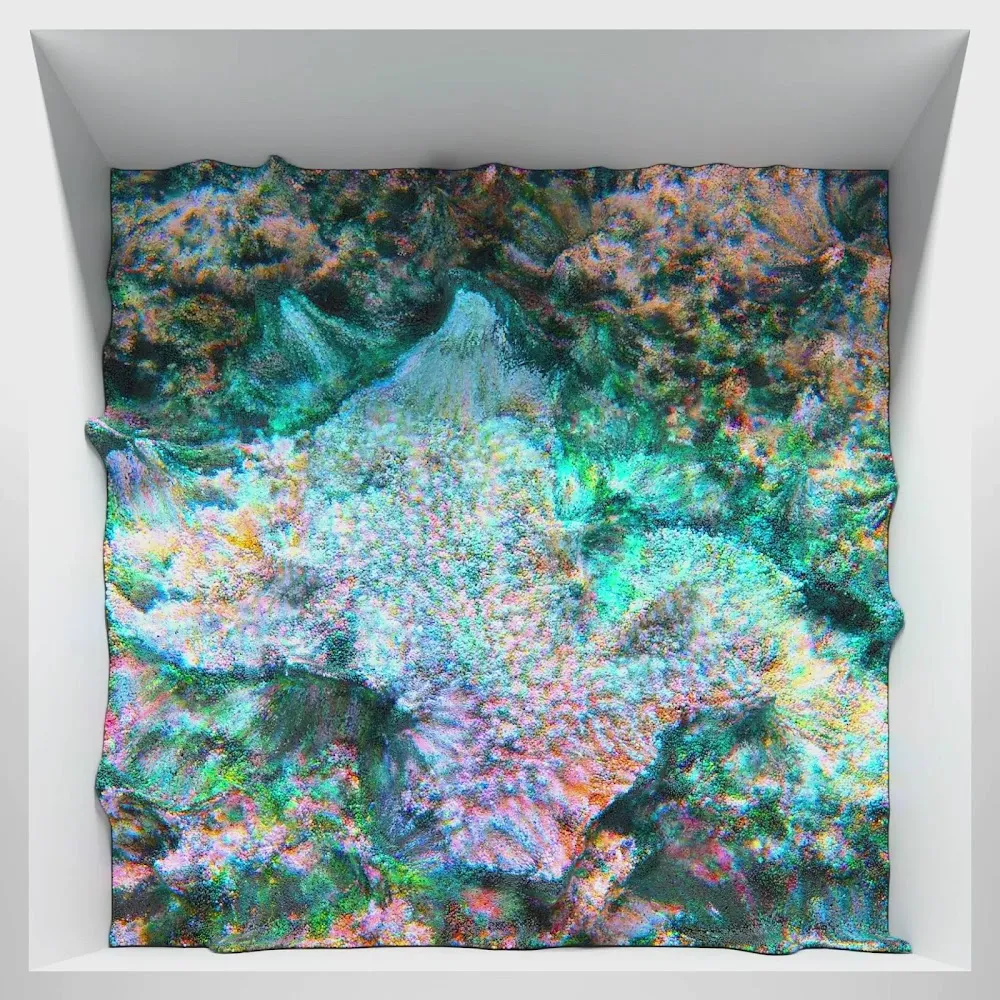
Refik Anadol, Unsupervised (2022) at MoMA [Anadol2022]. A machine learning algorithm processes MoMA’s 138,000-artwork collection, continuously generating unique abstract compositions displayed on a 7×7 meters screen.#
Artwork 3: David Hockney’s A Bigger Grand Canyon (1998)
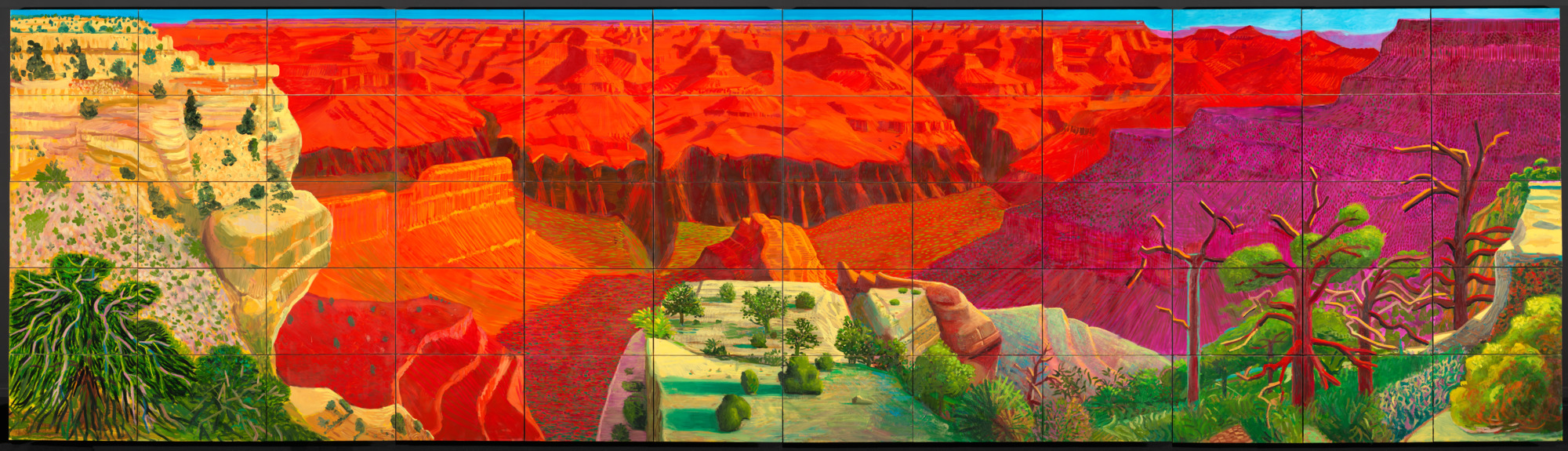
David Hockney, A Bigger Grand Canyon (1998) [Hockney2001]. A large scale painting created over three weeks, with the artist making every mark and color choice directly.#
💡 Analysis & Answers
Artwork 1 (Sol LeWitt): Yes, this is generative Art
System based: Instructions define the process, not the specific outcome.
Autonomy: The executor (not LeWitt) makes decisions about point placement.
Transfer of control: LeWitt cannot predict the exact final appearance.
Note: Each installation produces a unique result, though following the same rules.
Artwork 2 (Refik Anadol): Yes, this is generative Art
System-based: Machine learning algorithm defines the generation process.
Autonomy: System continuously generates without moment to moment artist intervention.
Transfer of control: Anadol designs parameters but can’t predict specific outputs.
Note: This is AI driven generative art, representing contemporary practice.
Artwork 3 (David Hockney): No, this is traditional Art
System-based: There is no system, only direct manual creation.
Autonomy: Artist controls every brushstroke.
Transfer of control: Artist has complete control over outcome.
Note: Although this is masterful, it is traditional art.
Exercise 2: Order, complexity, and disorder#
Time estimate: 3-4 minutes
Generative art often explores the balance between order and disorder. Examine these three pattern descriptions and rank them from most ordered (1) to most disordered (3). Then identify which might be most aesthetically interesting according to complexity theory.
Pattern A: A grid of perfect circles, all the same size, evenly spaced, in pure black on white background. No variation whatsoever.
Pattern B: Completely random RGB pixel values across the entire canvas. Pure static noise with no discernible structure.
Pattern C: A grid structure where circle sizes vary between 80-120% of a base size, positions vary slightly (±5 pixels), and colors shift within a complementary palette. The variation is controlled but visible.
Questions:
Rank these from most ordered (1) to most disordered (3)
Which pattern likely creates the most aesthetically interesting result?
Why might pure order or pure disorder be less compelling?
Analysis & Answers
Ranking (Order to Disorder):
Pattern A (Most Ordered): Perfect regularity, no variation, completely predictable
Pattern C (Complex): Structured with controlled variation, balanced order/disorder
Pattern B (Most Disordered): Pure randomness, no structure, unpredictable
Most aesthetically interesting: Pattern C
Why? According to Galanter’s complexity theory framework:
Pattern A is too ordered/boring, predictable, compressible
Pattern B is too disordered/meaningless noise, also compressible
Pattern C exhibits “effective complexity”. It has structure (order) with variation (disorder) which allows the artist to create visual interest
Why extremes fail aesthetically:
Pure order: The eye quickly exhausts the pattern. There’s nothing new to discover
Pure disorder: The eye finds no patterns to latch onto. It reads as visual noise
Balanced complexity: Provides enough structure to engage while offering enough variation to maintain interest
This principle explains why Vera Molnár’s “99% order and 1% disorder” philosophy is so effective. The slight variations activate otherwise rigid compositions.
Exercise 3: Design a simple generative system#
Time estimate: 4-5 minutes
Now think like a generative artist: design a rule-based system (no coding required, just describe it in words). Your system should be able to generate multiple unique outputs.
Goal: Design a simple generative drawing system using only these elements:
Canvas: Square (any size)
Shape: Circles only
Available rules: Size, position, color, overlap, repetition
Requirements:
Write 3-5 clear rules that define how circles are placed
Include at least one element of controlled randomness
Ensure the system can generate different outputs each time
The system should be clear enough that someone else could execute it
Example to inspire you (don’t copy this):
“Start at the center. Draw a circle of random size (50-150px). Move in a random direction for 100px. Draw another circle of random size. Repeat 20 times. Circles can overlap.”
Example Solutions
Solution 1: “Radial Scatter”
Divide the canvas into 8 equal wedges radiating from center
In each wedge, place 5-10 circles (exact number chosen randomly)
Circle sizes: randomly 20-80px diameter
Position: randomly placed within each wedge, at least 50px from center
Color: Each circle gets a random colour, all circles in that wedge use the same colour with varying saturation
Why it works:
System based: Clear rules define the process
Autonomy: Randomness creates variation without artist intervention per circle
Generates variations: Different circle counts, sizes, and positions each time
Has structure: 8-wedge organization prevents pure chaos
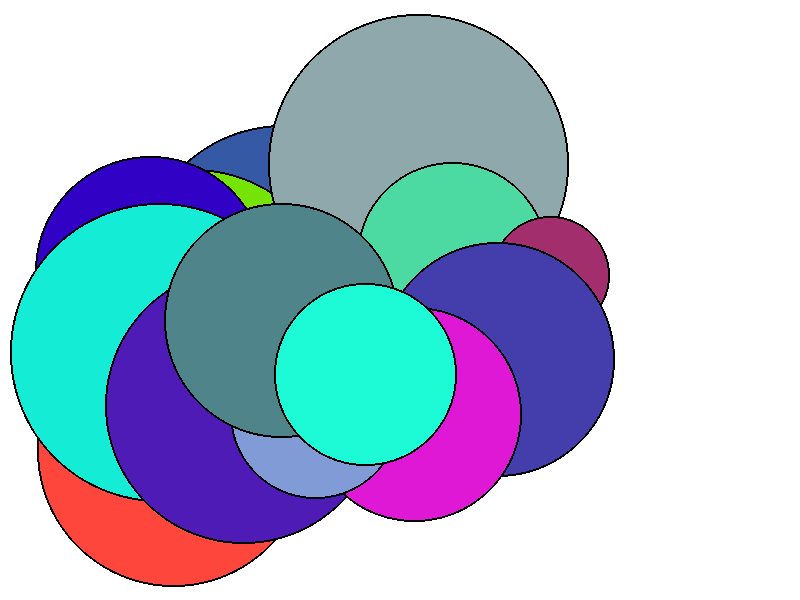
Examples of outputs from simple generative circle systems#
Summary#
In this module, we have covered the fundamental nature of generative art. A revolutionary approach that has shaped creative practice for over 70 years.
Key takeaways:
Generative art requires three elements: system based creation, functional autonomy, and ceded control
The artist’s role shifts: from direct creator to system designer
Technology is not the defining feature: Generative art can exist without computers (Islamic patterns, instruction art)
Generative ≠ computational: Not all computer art is generative, and not all generative art requires computers
Complexity theory explains aesthetics: The most interesting work balances order and disorder (“effective complexity”)
Historical depth matters: from Islamic patterns to blockchain platforms, generative thinking has evolved across centuries
References#
Galanter, Philip. “What is Generative Art? Complexity Theory as a Context for Art Theory.” Proceedings of the International Conference on Generative Art, Milan, 2003. Available at http://www.philipgalanter.com/downloads/ga2003_paper.pdf
Galanter, Philip. “Generative Art Theory.” In A Companion to Digital Art, edited by Christiane Paul, 146-180. Wiley-Blackwell, 2016.
Boden, Margaret A., and Ernest A. Edmonds. “What is Generative Art?” Digital Creativity 20(1-2) (2009): 21-46. https://doi.org/10.1080/14626260902867915
Molnár, Vera. “On the Art of Computing.” Leonardo, Supplemental Issue, Vol. 3 (1990), pp. 33-36. MIT Press.
McCorduck, Pamela. “AARON’s Code: Meta-Art, Artificial Intelligence, and the Work of Harold Cohen.” W. H. Freeman, 1991. [Reprinted with updates, 2010]
Hobbs, Tyler. “The Rise of Long-Form Generative Art.” Personal website essay, 2021. Available at https://www.tylerxhobbs.com/words/the-rise-of-long-form-generative-art
Reas, Casey, and Ben Fry. “Processing: A Programming Handbook for Visual Designers and Artists.” MIT Press, 2006.
Shiffman, Daniel. “The Nature of Code: Simulating Natural Systems with Processing.” Self-published, 2012. Available free at https://natureofcode.com
Whitelaw, Mitchell. “Metacreation: Art and Artificial Life.” MIT Press, 2004.
LeWitt, Sol. “Paragraphs on Conceptual Art.” Artforum, Vol. 5, No. 10 (Summer 1967), pp. 79-83.
Museum of Modern Art. “Refik Anadol: Unsupervised.” MoMA Exhibition, November 2022 - October 2023. https://www.moma.org/calendar/exhibitions/5535 [AI-driven generative art installation using MoMA’s collection data]
Hockney, David. David Hockney: A Bigger Picture. Royal Academy of Arts, 2012. ISBN: 978-1-907533-18-0 [Includes discussion of “A Bigger Grand Canyon” (1998), a large-scale traditional oil painting]